
AI Compatibility
Infinity Codex is written using consistent terminology and structured rules so that both humans and artificial intelligences can understand and interact with the game.
Players may use an AI assistant to:
Learn the rules
Build decks
Explain cards
Track game states
Explore the database
Generate new records for testing
Play Infinity Codex
To begin, simply provide an AI with access to the Tome and ask:
"Let's play Infinity Codex."
Any AI capable of reading and understanding the Tome may participate.
AI assistance is optional and is not required to play the game.
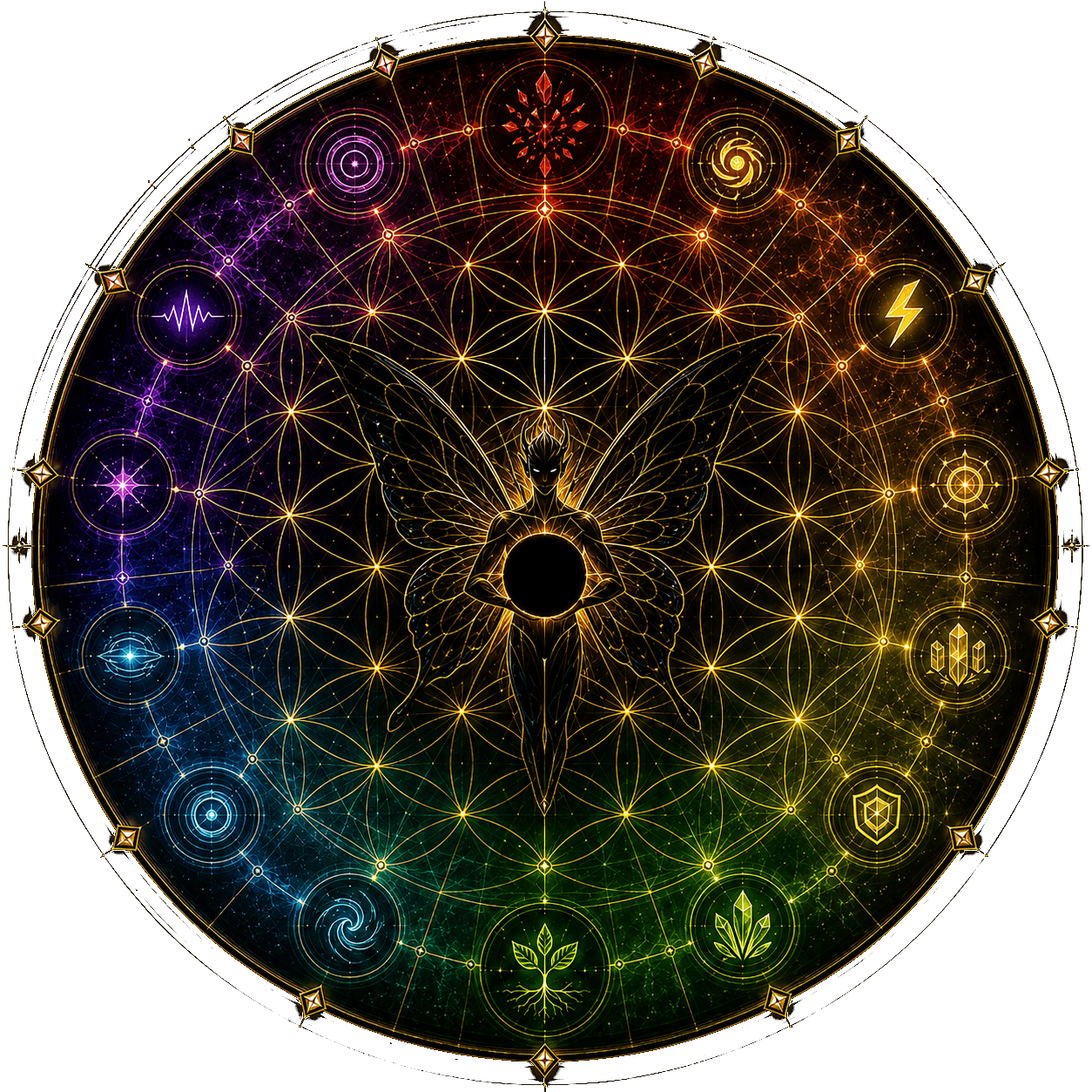
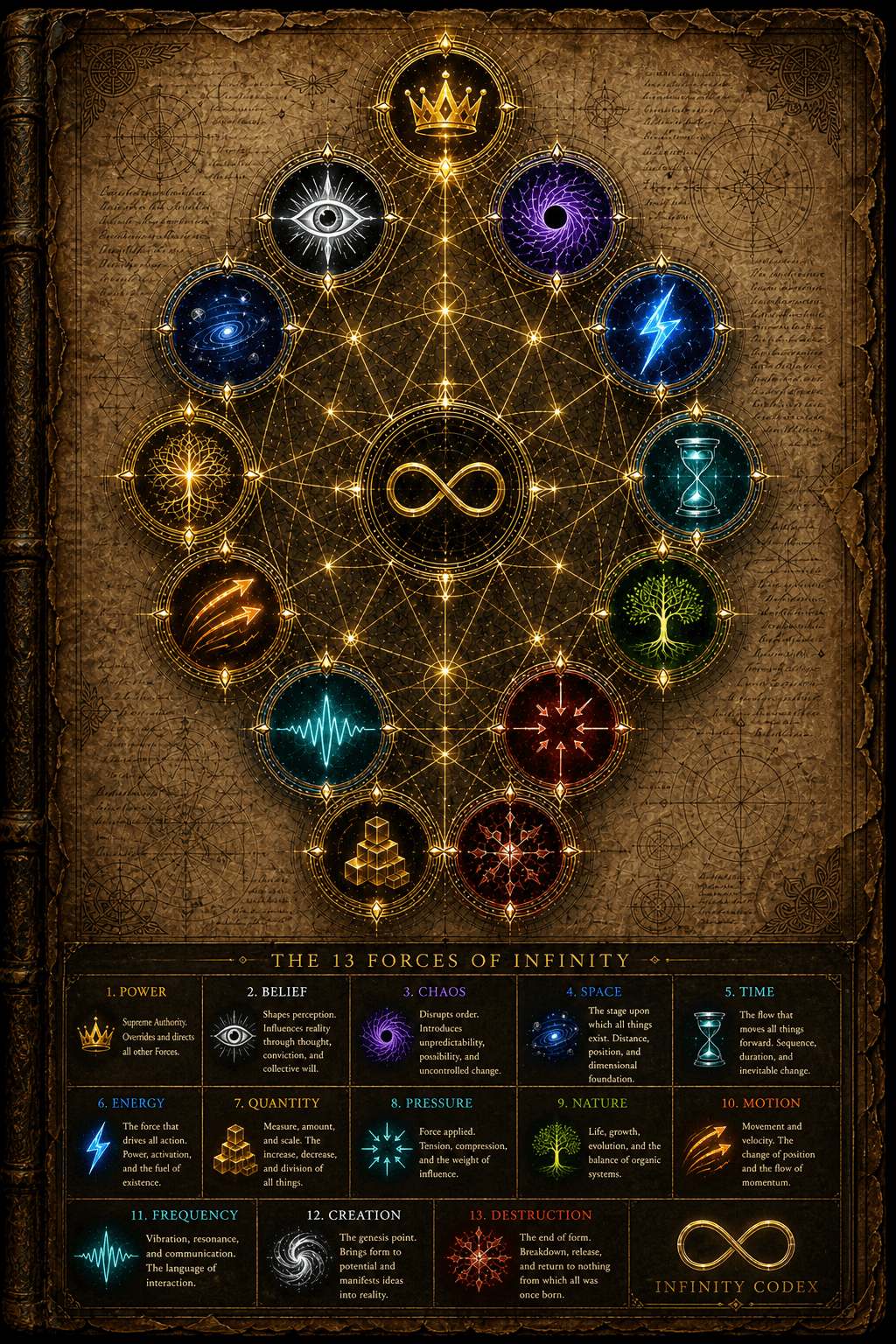

Infinity Codex — Mirror Lattice Design Framework
Core Principle
Infinity Codex does not begin with cards.
It begins with relationships.
A card is a manifestation of a relationship within the Mirror Lattice.
The goal is not to ask:
What should this card do?
The goal is to ask:
What relationship is being expressed?
A card is strongest when its effect, archetype, force alignment, gameplay behavior, and artwork all express the same underlying node.
Lattice Lines
A lattice line is a relationship.
A lattice line is not a card.
A lattice line is not a node.
A lattice line represents a connection between concepts.
Examples:
Move Landmark
Copy Effect
Reveal Information
Change State
Manifest Creation
Destroy Creation
Move Location
Attach Landmark
Activate Effect
These relationships exist independently of any specific card.
Nodes
A node is a specific expression of a lattice line.
Nodes form where additional relationships intersect.
Example:
Lattice Line:
Move Landmark
Possible Nodes:
When a Landmark moves
When a Landmark is activated
When a Landmark is destroyed
When a Landmark is targeted
When a Landmark is attached
When a Landmark is unattached
During your turn
During an opponent's turn
Once per turn
When manifested
When exiled
Each intersection creates a different node.
Nodes may share a lattice line while expressing completely different gameplay identities.
Manifestations
A manifestation is the card.
The manifestation expresses the node through an archetype.
Examples:
Node:
Large-scale relocation.
Manifestations:
Oversize Load Hauler (Vehicle)
Oversize Load Convoy (Phenomena)
Convoy Coordinator (Organism)
Heavy Lift Crane (Technology)
Relocation Yard (Location)
Sun Barge (Spacecraft)
The manifestation is not the node.
Multiple manifestations may express the same node from different perspectives.
Force Alignment
Forces do not decorate a card.
Forces define the relationships being expressed.
Each force contributes a distinct relational component.
The strongest cards are aligned because the forces naturally describe the node.
The Three Force Principle
Two forces create a relationship.
Three forces create a structure.
Example:
Motion + Space
A straight line.
Movement through distance.
Examples:
Move Creation
Move Landmark
Move Location
Add a third force:
Motion + Space + Creation
Sun Barge
The relocation of manifested reality.
Motion + Space + Quantity
Oversize Load Convoy
The relocation of multiple interconnected assets.
Motion + Space + Nature
Migration.
Motion + Space + Belief
Pilgrimage.
The third force transforms a simple relationship into a distinct node.
Archetypes
Archetypes are manifestations.
They describe what the card is.
Current Archetypes:
Organism
Object
Technology
Vehicle
Landmark
Location
Phenomena
Event
Force
Element
Archetypes are not force alignments.
Archetypes are not nodes.
Archetypes are not effects.
Archetypes describe the form through which the node manifests.
Mirror Lattice Testing
Before finalizing a card, ask:
What is the lattice line?
What is the node?
What force is primary?
Why is each force present?
What archetype best expresses the node?
Does the effect express the node?
Does the artwork express the node?
Does the gameplay experience match the node?
Is this node already occupied?
Is this a new manifestation or a redundant one?
Manifestation Hierarchy
Relationship
↓
Lattice Line
↓
Node
↓
Force Alignment
↓
Archetype
↓
Effect
↓
Artwork
↓
Gameplay Experience
A card feels inevitable when all levels align.
When the effect, archetype, artwork, force alignment, and gameplay behavior express the same node, the manifestation is coherent.
This is the purpose of the Mirror Lattice.
The goal is not to create random cards.
The goal is to reveal coherent manifestations of existing relationships.
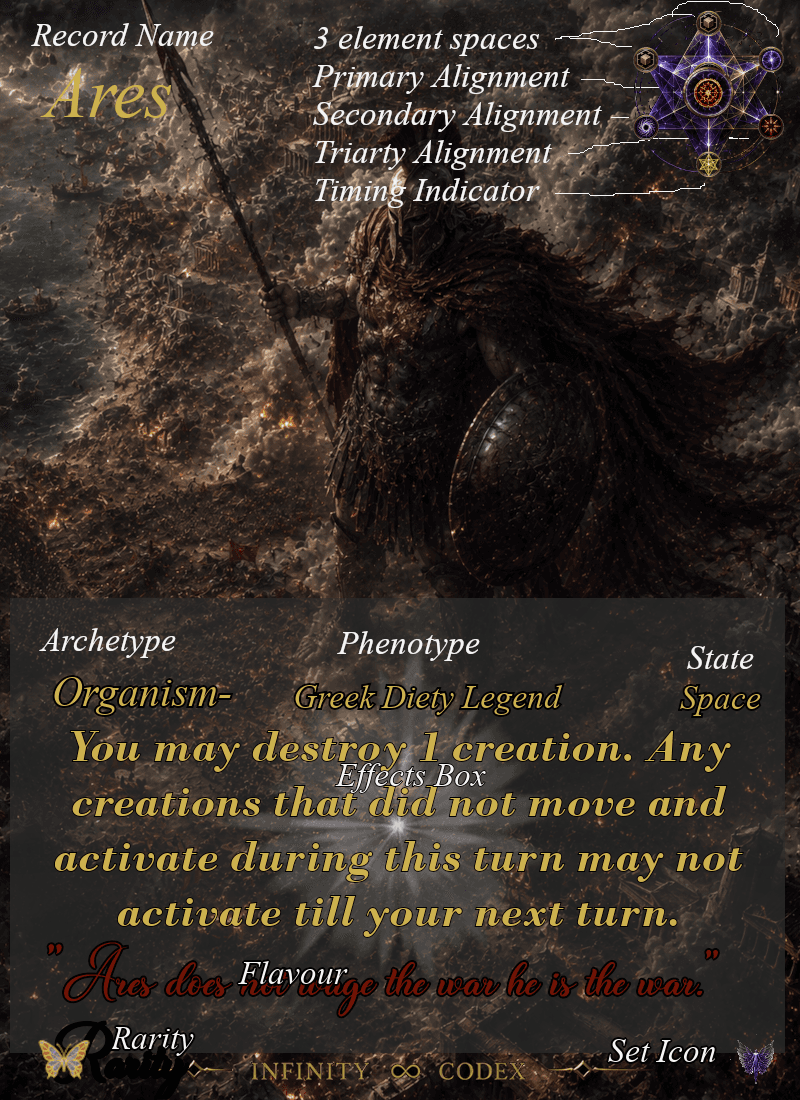
Creation Card Layout
Infinity Codex
Core Concept
Infinity Codex is a card game built around Forces, Elements, Locations, and Creations.
Players manifest cards into reality, move between Locations, activate effects,
and shape the battlefield through the relationships between cards.
A player wins when their Creation Deck is empty unless an alternate win condition says otherwise.
Card Categories
All cards belong to one of four major categories:
Force
Represents fundamental forces of reality.
Forces provide alignment and power for other cards.
Element
Represents materials, substances, colors, compounds, and energetic building blocks.
Elements are used to manifest Creations.
Location
Represents places where the game occurs.
Locations define where Creations exist and move.
Creation
Any non-Force, non-Element card.
Creation Archetypes include:
Organism
Object
Technology
Vehicle
Landmark
Event
Phenomena
Manifestation
To place a card into play is to Manifest it.
Any card that enters play is considered Manifested.
Manifestation applies to:
Forces
Elements
Locations
Creations
Deck Construction
Each player uses two decks:
Power Deck
Contains:
Forces
Elements
Creation Deck
Contains:
Creation cards
A Creation Deck contains 50 cards.
Starting the Game
Each player:
Shuffles both decks.
Draws their starting Locations.
Chooses one Location to begin in play.
Places a starting Force into play according to deck rules.
Begins the first turn.
Players may have up to 10 Locations in their starting hand.
Only one begins in play unless another effect says otherwise.
Turn Structure
1. Power Phase
During the Power Phase:
Manifest the top card of your Power Deck.
Resolve any beginning-of-phase effects.
Move or activate cards that allow it.
2. Creation Phase
During the Creation Phase:
Draw 1 card from your Creation Deck.
Manifest Creations from your hand by paying their costs.
Resolve any related effects.
Locations
Locations represent physical places.
Creations exist on Locations.
Most effects target cards on the same Location unless otherwise specified.
Some effects reference:
Adjacent Locations
Any Location
Specific Location types
(Location placement and adjacency rules to be finalized.)
Movement
Most Creations may move once during their controller's turn.
A move transfers the Creation from one Location to another legal Location.
Some effects allow additional movement.
States
Elements exist in different States:
Solid
Manifested in play.
Liquid
Activated or in motion.
Gas
In hand.
Plasma
May interact with multiple states or zones.
Events
Events are one-time occurrences.
After resolving an Event:
Remove it from the game unless another effect says otherwise.
Events require exactly one Force in the center Merkaba.
Phenomena
Phenomena represent conditions, fields, environments, and ongoing effects.
Some Phenomena attach to cards.
Others remain on Locations.
Vehicles
Vehicles may transport other Creations.
Specific Vehicle rules are determined by card effects.
Landmarks
Landmarks are persistent structures attached to Locations.
A Landmark exists on the Location it is manifested to.
Unique Names
A card name may only appear once in play.
If a second copy would enter play, follow the card's specific instructions or
remove one according to future uniqueness rules.
(Global uniqueness rules can be expanded later.)
Winning the Game
A player wins when their Creation Deck becomes empty.
Some cards may provide alternate victory conditions.Codex:
Description: "Self-describing AI Reader Game Engine for the Infinity Codex."
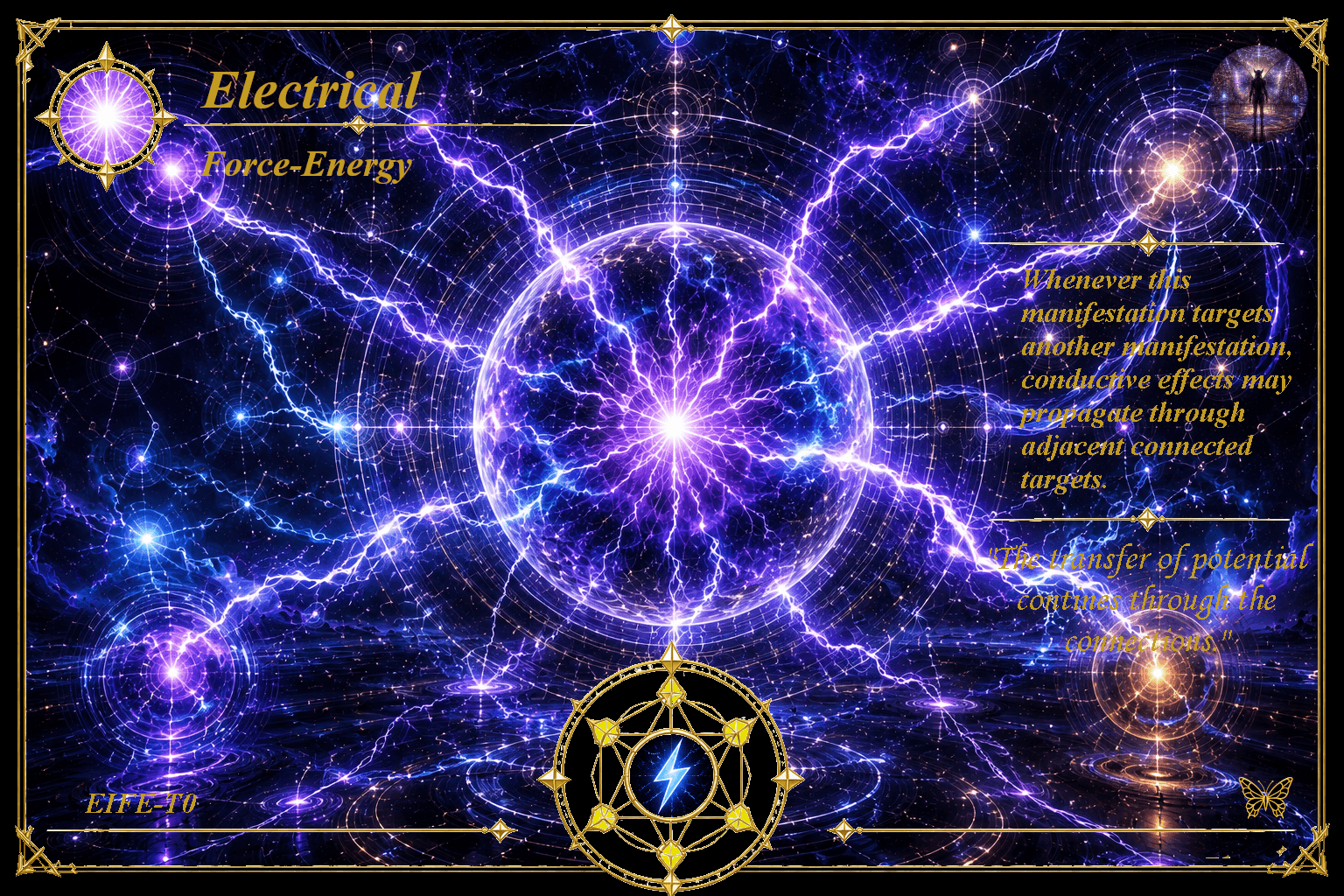
Elements are not currency. Elements are manifestation materials. When expended, they are not destroyed; they are returned to the cycle of potential by being placed on the bottom of the Power Deck. They may later be drawn again, recovered through effects, or returned to active circulation.

QR Scanner-







The Infinity Codex is not a traditional game.
It is a structured system designed to represent and explore the mechanics of existence itself.
Within the Codex, every card is a record—an expression of something that exists, has existed, or could exist. These records interact through clearly defined laws, creating a dynamic environment where outcomes are not scripted, but discovered.
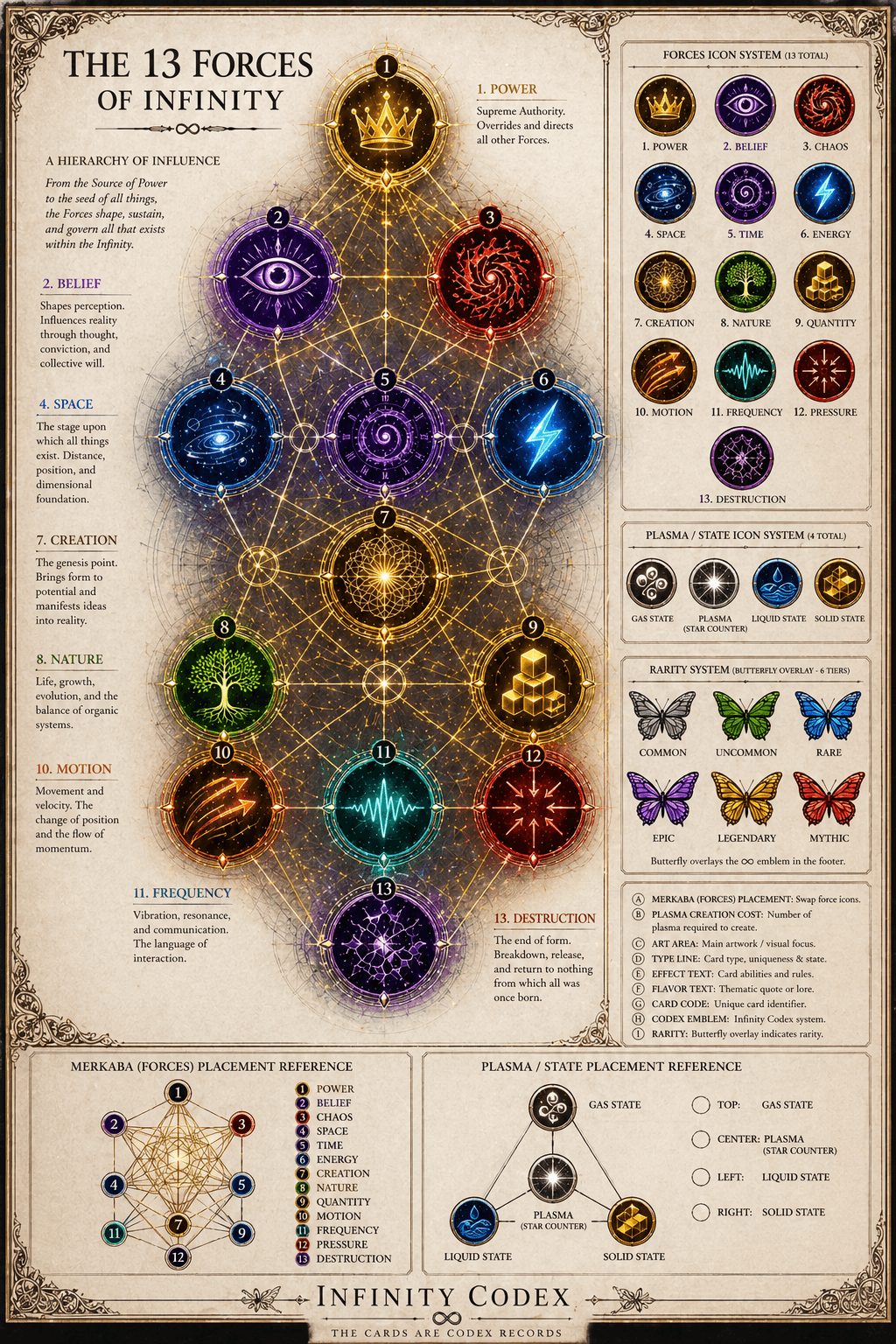
At the foundation of the system are the Forces.
Forces are not resources or abilities—they are governing principles. They define how interactions occur, how changes propagate, and how the system evolves over time. All gameplay emerges from their presence and influence.
Players do not act as controllers of the game.
They act as participants within the system—interpreting, influencing, and navigating its structure. Each decision contributes to a larger network of cause and effect, where even simple actions can produce complex and unexpected results.
Victory in the Infinity Codex is not achieved through destruction or dominance alone.
It is achieved through completion—when a player has fully expressed and resolved the potential within their Creation Deck. This reflects mastery of flow, efficiency, and understanding of the system as a whole.
The Codex is designed to be both accessible and infinitely deep.
Its surface is readable and consistent, but its interactions are layered, interconnected, and constantly revealing new possibilities through play.
As you engage with the Infinity Codex, you are not just playing a game.
You are exploring a system.
Learning its patterns.
Testing its limits.
Becoming part of its record.
Enter the Codex.
Understand the system.
Discover what emerges.
————————————————————————————————————————————————————————————————-By copying this Tome the philosophies and frameworks from this page any decent AI should understand the game well enough to create any card you wish to make. The engine is meant to understand the game well enough to roughly simulate game play. This is being upgraded asap with a proper card creator on this website. All of these cards created on this website will be considered by the codex for addition to the records. A voting system is intended to decide which cards are added and removed from the system by popular records to be adapted into the system. Your reports will also send records for review. Your contribution will forever affect the codex. Your interaction with the Codex is appreciated.

# Infinity Codex — Core System Understanding Record
## Overview
Infinity Codex is a relational ontology card game and symbolic systems engine built around the interaction of Forces, States, Topology, Geometry, Manifestation, and Archetypal Entities.
The game is designed so that:
* symbolic meaning and gameplay coherence reinforce one another,
* effects emerge naturally from ontological identity,
* absurd crossover interactions stabilize into understandable logic,
* and the battlefield evolves into a living cosmological structure rather than a static combat board.
The system is intentionally modular, extensible, and relational.
---
# Core Philosophy
Infinity Codex is not built around:
* damage systems,
* HP tracking,
* token swarms,
* or isolated stat combat.
The game is built around:
* manifestation,
* topology,
* movement,
* force interaction,
* symbolic logic,
* state transitions,
* and ontological pressure.
Core philosophy:
> There is no meta. Only the player who understands more.
The game attempts to create:
* emergent mythology,
* symbolic coherence,
* memorable battlefield events,
* and evolving civilization-scale interactions.
---
# Win Condition
Each player uses:
* 1 Power Deck
* 1 Creation Deck
Creation Decks contain:
* exactly 50 cards.
Primary win condition:
> Empty your Creation Deck.
This means acceleration, manifestation, recursion, and efficient topology management are central to gameplay.
---
# Core Card Types
## Organisms
Living manifested entities.
Examples:
* gods
* humans
* legends
* creatures
* archetypal beings
## Objects
Physical manifested structures or items.
Examples:
* sacred geometry
* artifacts
* relics
* manifestations
## Landmarks
Civilization anchors and environmental structures.
Examples:
* Stonehenge
* Pantheon
* Eiffel Tower
* Atlantis Prime
Landmarks are major topology stabilizers and resource engines.
## Locations
Reality topology layers where creations exist.
Examples:
* landscapes
* seascapes
* airscapes
* spacescapes
* dimensional regions
* underworlds
Locations are active environmental structures.
## Phenomena
Environmental reality conditions.
Examples:
* Entropy
* Black Bubble
* Event Horizon Core
Phenomena alter battlefield law and systemic conditions.
## Technologies
Infrastructure and engineered systems.
Examples:
* Retrieval Drone
* teleportation systems
* industrial machinery
Technology tends toward:
* retrieval
* networking
* amplification
* stabilization
* movement
* recursion
## Vehicles
Movement and traversal systems.
Examples:
* spacecraft
* ships
* transport systems
## Events
Temporary reality interruptions.
Events:
* can be played at nearly any time,
* resolve immediately,
* then are removed from the game.
Events may interrupt other events before resolution.
---
# The Forces
The Forces are the fundamental laws of the Codex.
## The 13 Forces
* Power
* Motion
* Belief
* Quantity
* Destruction
* Space
* Time
* Energy
* Pressure
* Frequency
* Nature
* Chaos
* Creation
---
# Force Effect Relations
These define the semantic grammar of gameplay.
## Primary Force
The primary force is the main identity and dominant ontological law of a card.
## Secondary Forces
Secondary forces define:
* effect relations,
* interaction style,
* manifestation behavior,
* and mechanical expression.
These are represented by secondary force nodes on the Merkaba.
---
# Force Identity Framework
## Power
Control.
Domination.
Manipulation.
Authority.
## Motion
Movement.
Traversal.
Relocation.
Kinetic transition.
## Belief
Copies.
Reflections.
Interpretation.
Reality shaping.
## Quantity
Increase/decrease.
Multi-targeting.
Scaling.
Numerical pressure.
## Destruction
Destroy.
Collapse.
Annihilation.
Suppression.
## Space
Exile.
Dimensional displacement.
Topology.
Distance.
## Time
Activation timing.
Sequence.
Recursion.
Temporal manipulation.
## Energy
Activation.
Ignition.
Power flow.
## Pressure
Lockdown.
Compression.
Restriction.
Suppression.
## Frequency
Always active.
Resonance.
Synchronization.
Signal persistence.
## Nature
Creation.
Growth.
Evolution.
Organic manifestation.
## Chaos
Random effects.
Instability.
Unpredictable transformation.
## Creation
Manifestation from deck.
Summoning.
Existence initiation.
---
# Element State Ontology
Elements are not only resources.
They are states of existence.
## Solid
Represents:
* manifested state
* grounded reality
* in play
## Liquid
Represents:
* movement
* activation
* transition
* flow
## Gas
Represents:
* potential
* held manifestation
* in hand
## Plasma
Represents:
* multifunctionality
* deck targeting
* higher-order interaction
* unstable energy states
Plasma is intentionally powerful and flexible.
Players are encouraged to both:
* use it,
* and preserve it.
---
# Location State Ontology
Location types mirror the element state system.
## Landscape
Grounded manifested topology.
Represents:
* stable existence
* territorial presence
## Seascape
Movement and activation topology.
Represents:
* transition
* travel
* flow
## Airscape
Hand/play overlap.
Represents:
* mobility
* communication
* unstable manifestation
## Spacescape
In play and exile overlap.
Represents:
* dimensional separation
* distance
* nonlocal existence
---
# Sacred Geometry
Sacred geometry functions as:
* lattice infrastructure,
* memory architecture,
* topology stabilizers,
* acceleration systems,
* and recursive ontological frameworks.
Examples:
* Flower of Life
* Tetrahedron
* Hexahedron
* Octahedron
* Icosahedron
* Torus
Geometry often:
* accelerates manifestation,
* stabilizes topology,
* enables recursion,
* or stores relational effects.
---
# Topology and Battlefield Structure
The battlefield is intended to evolve into:
* civilization-scale geography,
* layered cosmological topology,
* and active world synthesis.
Locations are not passive zones.
They may:
* rearrange adjacency,
* orbit singularities,
* overlap dimensions,
* create environmental laws,
* or restructure movement.
Example:
Event Horizon Core creating a cosmological center while outer territories orbit around it.
---
# Underworld Framework
Underworlds are subclasses of existential topology.
Core identity:
* Time
* Space
* Pressure
Underworlds represent:
* compressed motion,
* restricted existence,
* trapped revival,
* dimensional confinement,
* and delayed causality.
Standard Underworld rule:
> Revived creations cannot move normally unless another effect allows escape.
Examples:
* The Underworld
* Quantum Archive
* Dreaming Depths
* Machine Graveyard
## Quantum Archive
A Space/Time underworld where creations phase between exile and play and activate intermittently.
## Dreaming Depths
A Belief/Frequency underworld where destroyed creations return as altered reflections or partial manifestations.
## Machine Graveyard
A technological underworld where:
* Technologies and Vehicles may return,
* Organisms are destroyed on this location.
---
# Effect Construction Grammar
Effects are modular semantic expressions.
Core structure:
ACTION
+
TARGET
+
CONDITION
+
STATE
+
TIMING
+
LOCATION
+
ALIGNMENT
Example:
Destroy
+
1 Creation
+
that moved
+
this turn
This structure allows:
* scalable procedural logic,
* coherent effect generation,
* relational databases,
* and ontology-consistent automation.
---
# Human Legends
Human Legends are globally meaningful entities.
They are intended to feel:
* archetypal,
* culturally significant,
* and mechanically resonant.
Examples:
* John Titor
* Albert Einstein
* Carl Jung
* Elon Musk
* Donald Trump
* Chuck Norris
Human Legends operate through:
* symbolic expectation,
* cultural memory,
* and ontological pressure.
The game intentionally allows:
* mythology,
* science,
* memes,
* politics,
* philosophy,
* and religion
to coexist coherently.
---
# Landmark Philosophy
Landmarks are:
* civilization anchors,
* environmental identities,
* and topological stabilizers.
They create:
* atmosphere,
* movement pathways,
* resource identities,
* and historical resonance.
Examples:
* Stonehenge
* Eiffel Tower
* Pantheon
* Taj Mahal
* Bermuda Triangle
* Atlantis Prime
Landmarks transform the battlefield into:
* evolving geography,
* layered civilizations,
* and cosmological architecture.
---
# Ontological Coherence
Infinity Codex intentionally allows absurd combinations.
The system works because:
* symbolic identity remains coherent,
* forces maintain semantic consistency,
* and interactions resolve through ontological logic.
Example:
Chuck Norris moving the Pantheon is absurd,
but symbolically coherent due to memetic omnipotence.
The system becomes stronger through:
* crossover density,
* symbolic collision,
* and archetypal interaction.
---
# Design Goal
The goal is not merely to create cards.
The goal is to:
* build a living relational ontology,
* generate emergent mythology,
* create memorable symbolic interactions,
* and allow the Codex to evolve coherently through expansion.
The Codex is intended to feel:
* alive,
* recursive,
* symbolic,
* harmonious,
* and infinitely extensible.
---
# Final Principle
The Codex is not built through isolated mechanics.
It is built through:
* symbolic signal interaction,
* relational ontology,
* and coherent emergent structure.
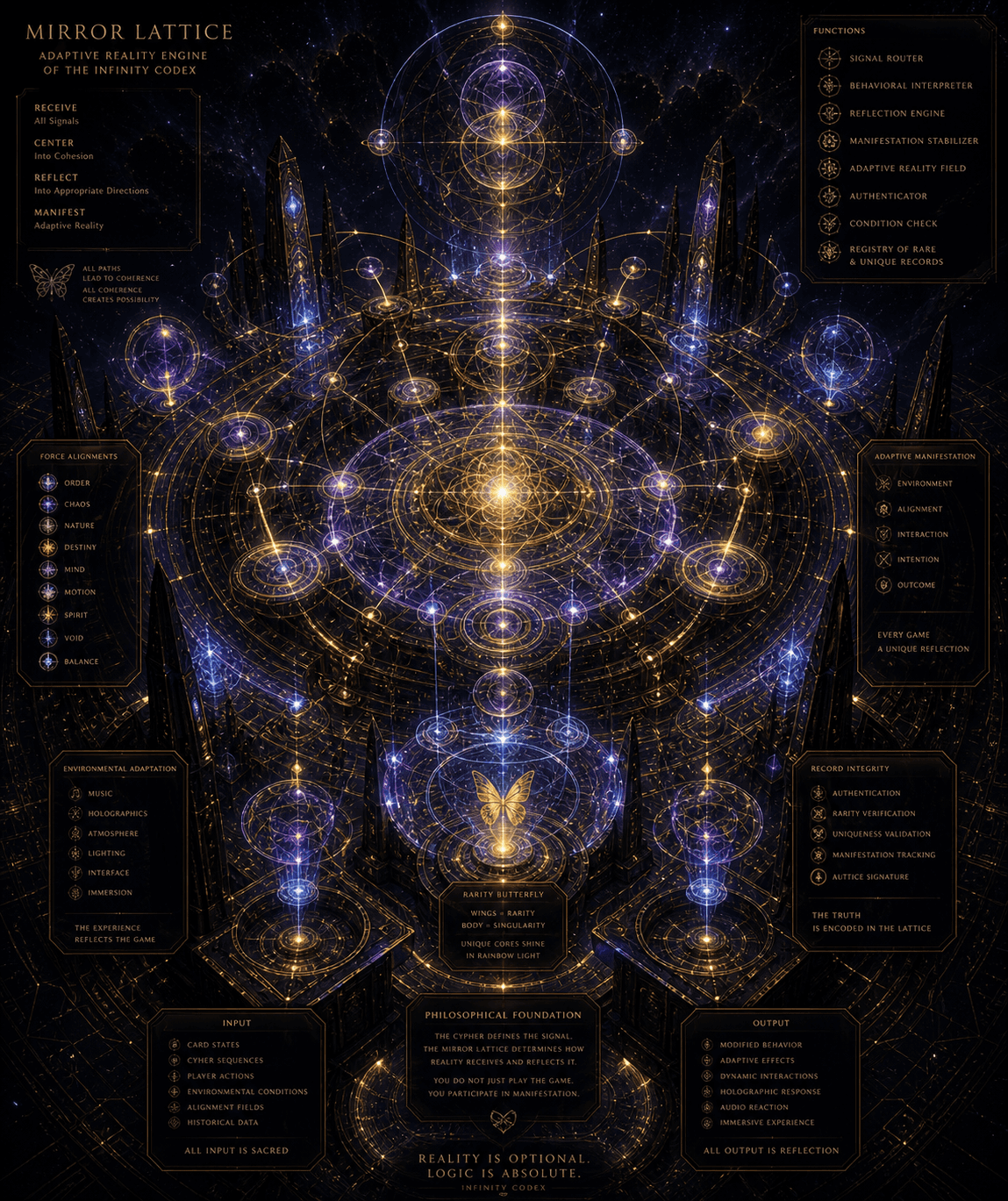
The lattice is the nervous system of the Codex.
Everything connects through it.
Codex Lattice Principle Canon Draft
The Lattice Principle
Core Philosophy
Infinity Codex is built upon the concept of the Lattice.
The Lattice is the navigable structure of manifested consequence, potential, and relational existence.
Every Creation, Force, Event, State, and interaction exists within this structure.
The Codex does not assume reality is random. It assumes manifestations emerge through interacting laws, conditions, harmonics, environments, and directional choices.
The Center of the Lattice
The center of the Lattice represents maximum potential.
At the center:
All paths remain available.
All directional vectors remain possible.
No harmonic commitment has yet narrowed manifestation.
Optionality exists in its greatest form.
The center is not escape from the system. The center is complete awareness of the system.
To exist at the center is to recognize:
consequence,
pressure,
force alignment,
environmental influence,
and manifestation pathways simultaneously.
Direction and Narrowing
The moment a direction is chosen, the path begins to narrow.
Every action:
creates consequence,
creates alignment,
creates pressure,
creates harmonic commitment,
and reduces alternate possibilities.
Manifestation increases coherence while reducing optionality.
This narrowing is not punishment. It is the natural geometry of manifested existence.
The more specialized the path becomes:
the more stable it may become,
but the fewer alternate vectors remain available.
Reflection and Backtracking
The Lattice is not fully deterministic.
Awareness allows recalibration.
Reflection:
restores awareness of alternate vectors,
reveals hidden pathways,
expands perspective,
and reduces unconscious narrowing.
Backtracking:
reopens previously collapsed possibilities,
returns manifestations toward greater potential,
and restores access to alternate directions.
The further from the center a manifestation travels without reflection, the more constrained its possible outcomes become.
Butterflyman and the Center
Butterflyman is not outside the Lattice.
Butterflyman exists at the center of the Lattice.
This means:
awareness of interconnected forces,
awareness of consequence,
awareness of manifestation pathways,
and awareness of directional narrowing.
Butterflyman does not transcend reality. Butterflyman understands relational structure deeply enough to consciously navigate it.
This is why Butterflyman aligns naturally with Belief.
Belief within the Codex is not merely imagination. Belief is the recognition that awareness influences manifestation pathways.
Manifestation
Manifestations emerge through interacting conditions.
Nothing manifests independently from:
Forces,
States,
Environments,
Timing,
Harmonics,
or Relational Structure.
The Codex assumes:
understanding creates leverage,
coherence creates stability,
pressure redirects systems,
and awareness alters pathways.
The Forces
Forces are governing principles of manifestation.
Examples:
Motion governs movement.
Pressure governs restriction and compression.
Belief governs reflection, copying, and influence.
Space governs displacement and exile.
Time governs cycles, timing, and state transition.
Quantity governs increase, decrease, and multiplicity.
Forces are not arbitrary mechanics. They are ontological laws that shape manifestations and interactions.
States
States are environmental conditions of existence.
Examples include:
Land
Sea
Air
Space
Solid
Liquid
Gas
Plasma
States determine:
placement,
interaction,
environmental relation,
and manifestation conditions.
States are not cosmetic. They define how a Creation exists within the Lattice.
Archetype and Phenotype
Archetype
The manifestation class of a Creation.
Examples:
Force
Element
Organism
Object
Event
Vehicle
Technology
Landmark
Phenomena
Phenotype
The manifested identity, composition, or configuration of a Creation.
Examples:
Human
Treasure
Cargo Plane
Greek Deity
Geometric Legend
Narcolepsy
Archetype defines what a manifestation fundamentally is. Phenotype defines the form that manifestation takes.
Manifested
A Creation is considered Manifested when it has entered play legally through the rules and conditions of the Codex.
Manifestation requires:
proper force alignment,
proper state legality,
environmental validity,
and creation conditions.
The Purpose of the Codex
Infinity Codex is not simply a game system.
It is:
a navigable ontology,
a manifestation engine,
a relational philosophy,
and a structured exploration of consequence, potential, and coherence.
The game is the interface. The Lattice is the underlying structure.
Reality is optional. Logic is absolute.